
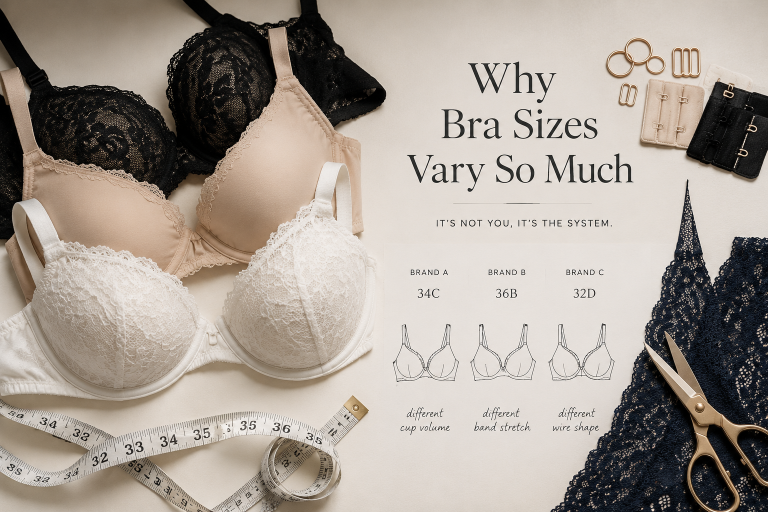
Why Bra Sizes Vary So Much
Ever wondered why you're a 36C in one brand and a 38B in another? Learn why bra sizes vary, how manufacturers design bras differently, and what really matters when finding your perfect fit.
Have you ever wondered why you're a 36D in one brand but a 38C in another?
You're not imagining it.
Manufacturers use different:
Cup patterns
Wire shapes
Stretch fabrics
Band elasticity
Design goals
Some brands are designed for fuller busts.
Others are designed for shallower breast shapes.
Some prioritize comfort.
Others prioritize appearance.
That's why one of the most frustrating experiences when shopping for bras is discovering that your "usual size" doesn't fit.
You finally find a bra labeled 36D that fits beautifully. Then you try another 36D from a different brand—and suddenly it's too tight, too loose, too shallow, or too deep.
It's enough to make anyone question their size.
The truth is, you're probably not the problem.
Bra sizing isn't standardized, and understanding why can make shopping much less frustrating.
There Is No Universal Bra Size Standard
(Hero image: Your "Why Bra Sizes Vary So Much" image.)
Unlike many products, there isn't one worldwide standard that every bra manufacturer follows.
Each company develops its own:
Patterns
Cup shapes
Underwires
Band elasticity
Sizing methods
Fit models
That means a 34DD from one brand may fit very differently from a 34DD made by another company.
The label may be the same—but the bra is not.
Every Brand Designs for a Different Customer
Not every lingerie company designs for the same body type.
Some brands specialize in:
Fuller busts
Petite frames
Fashion-forward styles
Everyday comfort
Sports bras
Luxury lingerie
As a result, their bras are built with different proportions, different support levels, and different expectations about the person wearing them.
Cup Shape Matters Just as Much as Cup Size
(Image showing two different cup shapes.)
Many women assume that cup letters tell the whole story.
They don't.
Two bras labeled the same size may have completely different cup shapes.
One may be:
Deeper
Shallower
Wider
Narrower
More open across the neckline
More closed at the top
That's why one bra may fit beautifully while another gaps or feels too tight—even though both have the same size on the tag.
The Band Makes a Difference
Band elasticity varies between manufacturers.
Some brands use firmer elastics.
Others use softer materials that stretch more easily.
This means:
One 36 band may feel like another brand's 34.
Another may feel closer to a 38.
It's perfectly normal to wear different band sizes in different brands.
Sister Sizes Can Help
(Image illustrating sister sizing.)
Sometimes adjusting both the band and cup provides a better fit.
For example:
34D
36C
38B
These are called sister sizes.
They have similar cup volume while changing the band size.
Understanding sister sizing can make it easier to find a comfortable fit when your preferred size isn't available.
Your Body Changes Over Time
Your bra size today may not be your bra size next year.
Many things affect fit, including:
Weight changes
Pregnancy
Breastfeeding
Hormonal changes
Menopause
Exercise
Surgery
Aging
It's completely normal for your bra size to change over time.
The Number on the Tag Isn't the Goal
One of the biggest mistakes women make is becoming attached to a particular size.
The goal isn't wearing a certain number or letter.
The goal is wearing a bra that:
Feels comfortable
Provides support
Fits your breast shape
Stays in place
Makes you feel confident
If that happens to be a different size than you expected, that's perfectly okay.
Why Professional Fittings Help
A professional fitter looks beyond the label.
Instead of focusing only on measurements, they evaluate:
Breast shape
Breast spacing
Projection
Root width
Support needs
Lifestyle
Comfort preferences
That's why professional fittings often produce better results than relying solely on a size calculator.
When a Custom Bra Is the Best Solution
Sometimes no amount of trying different brands solves the problem.
This is especially true for women with:
Significant asymmetry
Hard-to-find sizes
Post-surgical changes
Unique body proportions
Specialty wardrobe needs
A custom bra eliminates the guesswork by being designed specifically for your body rather than around standardized sizing.
The Bottom Line
Bra sizing is a helpful guide—but it's not an exact science.
Different brands, different patterns, different materials, and different breast shapes all influence how a bra fits.
Instead of chasing the "right" size, focus on finding the bra that feels right for your body.
That's the size that truly matters.
Ready to Stop Guessing?
At Lynnette January Design Studio, we believe the best-fitting bra begins with understanding your unique body—not simply reading the size on a label.
Whether you're searching for a better-fitting ready-to-wear bra, need alterations, or want a completely custom design, we're here to help.
If changing brands and sizes still hasn’t solved your fit problems, visit Lynnette January Design Studio during walk-in hours for a professional Bra Assessment & Fit Consultation. No appointment is necessary.
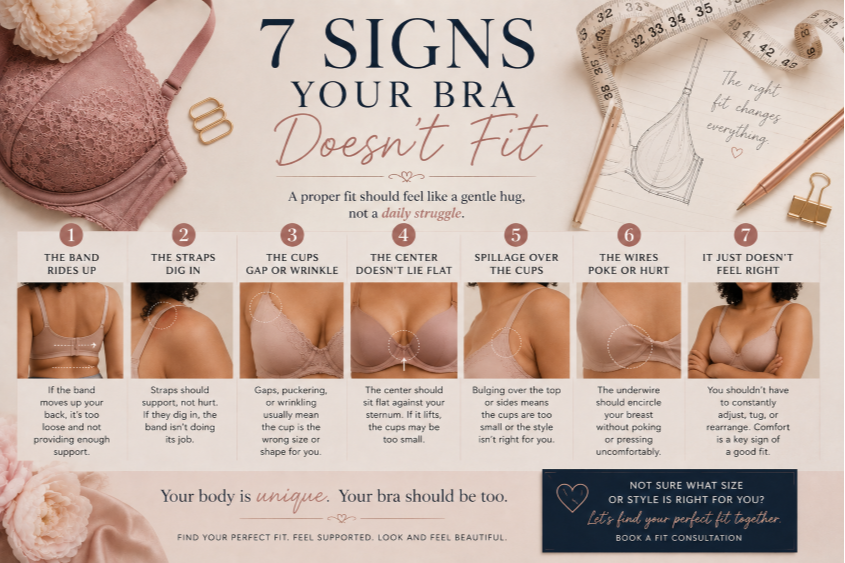
Seven Signs Your Bra Doesn't Fit
If your bra digs, gaps, rides up, or constantly needs adjusting, it may not fit as well as you think. Learn the seven most common signs of a poorly fitting bra—and how to fix them.
1. Your Band Rides Up
The band provides about 80% of your bra's support. If it creeps upward between your shoulder blades, it's probably too loose.
A properly fitted band should remain level all the way around your body.
2. Your Straps Dig Into Your Shoulders
Shoulder straps should stabilize the cups—not carry the weight of your breasts.
If your shoulders ache at the end of the day, your band may not be providing enough support.
3. The Center Doesn't Sit Flat
The center front of an underwire bra is called the gore.
On most underwire bras, the gore should rest comfortably against your breastbone. If it floats away from your chest, your cups may be too small, the wires may not match your breast shape, or that particular bra style simply isn't right for you.
4. You're Spilling Out of the Cups
If breast tissue is spilling over the top or sides of your cups, you probably need a different cup size—or a different cup shape.
Simply increasing cup size isn't always the answer.
5. Empty Space in the Cups
Wrinkling or gaping doesn't automatically mean the cups are too large.
It often means the cup shape doesn't match your breast shape.
A woman with shallow breasts may experience gaps in one bra while completely filling another of the exact same size.
6. Underwires Hurt
Many people believe underwires are uncomfortable.
In reality, a properly fitted underwire should surround your breast tissue—not sit on top of it.
Pain usually indicates the wrong wire width, the wrong cup shape, or an incorrect size.
7. You're Constantly Adjusting Your Bra
If you're tugging your band down, pulling your straps up, repositioning your cups, or readjusting throughout the day, your bra is telling you something.
A properly fitted bra should feel secure from morning until night.
If any of these signs feel familiar, bring your clean bra to Lynnette January Design Studio during walk-in hours for a professional Bra Assessment & Fit Consultation. No appointment is necessary.
If standard bras still aren't giving you the fit you need, explore our custom bra designs created for your individual measurements, shape, and support needs.