
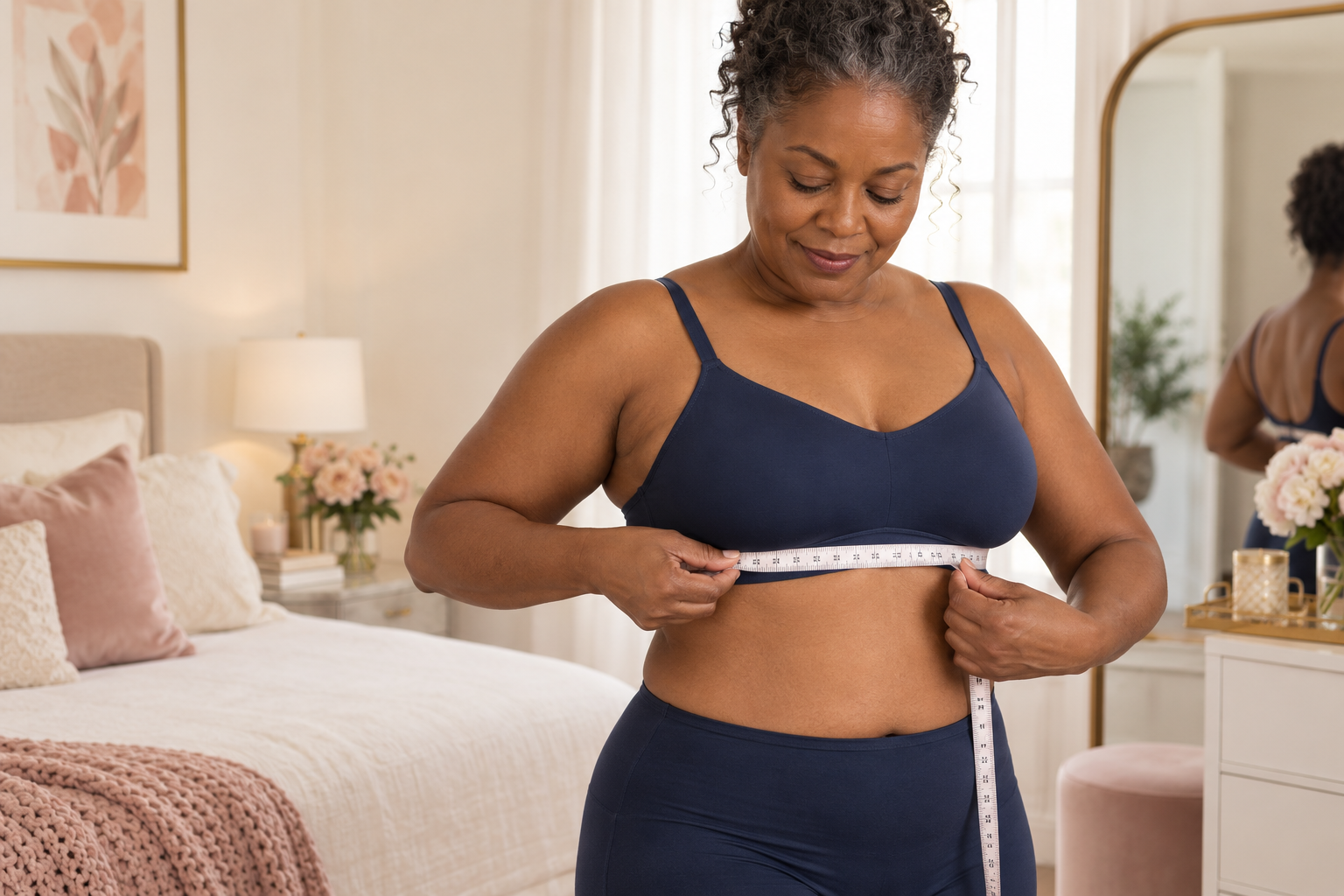
How To Measure Yourself For A Bra At Home
Measuring yourself for a bra is easier than you might think—but getting the best fit involves more than just numbers. Follow this step-by-step guide to take accurate measurements and understand what they really mean.
Finding a bra that fits comfortably starts with knowing your measurements.
Many women wear the same bra size for years without realizing that their body has changed. Weight fluctuations, pregnancy, surgery, aging, and even different bra brands can all affect how a bra fits.
Fortunately, measuring yourself at home is simple and only takes a few minutes.
While your measurements won't tell you everything about finding the perfect bra, they'll give you an excellent place to start.
What You'll Need
Before you begin, gather:
A soft measuring tape
A mirror
A non-padded bra (or no bra if you're comfortable)
A pen or phone to record your measurements
For the most accurate results, avoid measuring over heavily padded bras or bulky clothing.
Step 1: Measure Your Underbust
Stand naturally and wrap the measuring tape around your rib cage, directly beneath your breasts.
The tape should be:
Snug but not tight
Parallel to the floor
Level all the way around
Take a normal breath before recording the measurement.
This number helps determine your band size, which provides most of your bra's support.
Step 2: Measure Your Full Bust
Wrap the measuring tape around the fullest part of your bust.
Make sure the tape:
Stays level around your body
Doesn't compress your breasts
Isn't hanging loosely
Record the measurement to the nearest quarter inch if possible.
This measurement helps estimate your cup volume.
Step 3: Measure Your Upper Bust
Measure around your chest just above the fullest part of your breasts and under your arms.
Although not every size calculator uses this measurement, it can be extremely helpful when fitting custom bras and certain specialty styles.
Write Everything Down
By the time you're finished, you should have three measurements:
✔ Underbust
✔ Full Bust
✔ Upper Bust
These numbers provide an excellent starting point for selecting a bra.
Common Measuring Mistakes
Even small errors can affect your results.
Avoid these common mistakes:
Measuring over thick clothing
Pulling the tape too tightly
Letting the tape sag in the back
Wearing a heavily padded bra while measuring
Holding your breath
Assuming one measurement equals your perfect bra size
Accurate measurements are important—but they're only one part of achieving a great fit.
Why Measurements Aren't the Whole Story
This surprises many people.
Two women can have identical measurements and still need completely different bras.
Why?
Because breasts vary in:
Shape
Projection
Fullness
Root width
Spacing
Symmetry
Measurements tell us how big.
Breast shape tells us how a bra should be designed.
That's why two bras labeled the same size can fit so differently.
What If Your Measurements Fall Between Sizes?
Don't panic.
This is very common.
Bra sizing isn't perfectly standardized, and every manufacturer designs their bras a little differently.
You may wear one size in one brand and another size in a different style—and that's completely normal.
Focus on how the bra fits rather than the number on the tag.
When a Professional Fitting Makes Sense
Measuring yourself at home is a great first step.
However, you may benefit from a professional fitting if you:
Have difficulty finding bras that fit
Wear a larger cup size
Have uneven breast sizes
Have had breast surgery
Need post-mastectomy support
Experience neck or shoulder discomfort
Want a custom-made bra
A professional fitting evaluates not only your measurements but also your breast shape, support needs, lifestyle, and personal preferences.
Your Measurements Are Just the Beginning
Knowing your measurements gives you confidence when shopping for bras, but the perfect fit is about much more than numbers.
The right bra should feel comfortable, supportive, and secure while complementing your unique body.
Think of your measurements as the foundation—not the final answer.
Ready to Find Your Perfect Fit?
At Lynnette January Design Studio, every consultation begins with careful measurements and a personalized fit assessment.
Whether you're searching for a better everyday bra, need specialty support, or are considering a custom design, we're here to help.
Home measurements are a helpful starting point, but they cannot show every fit issue. Visit Lynnette January Design Studio during walk-in hours for a professional Bra Assessment & Fit Consultation. No appointment is necessary.
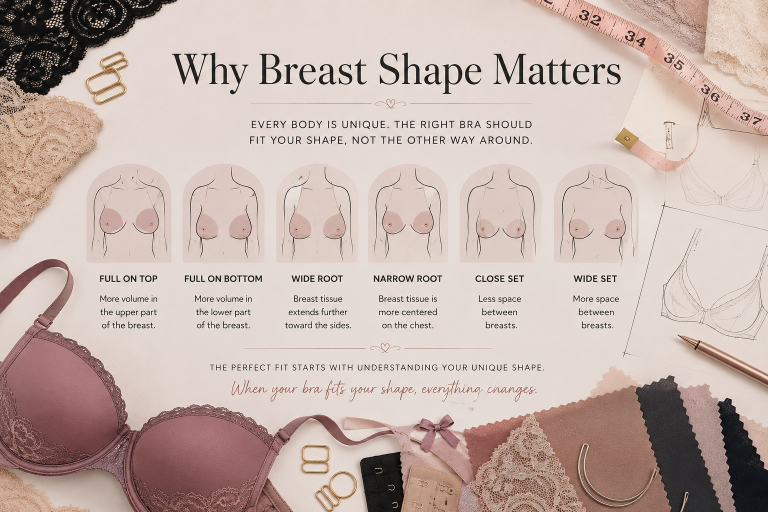
Why Breast Shape Matters
Did you know two women can wear the same bra size but need completely different bras? Discover why breast shape plays such an important role in comfort, support, and finding the perfect fit.
If you've ever tried on five bras in the same size and found that none of them fit quite right, you're not alone.
Many women assume they simply haven't found the right size.
In reality, the problem is often breast shape, not bra size.
Bra size tells us your approximate measurements.
Breast shape tells us how those measurements are distributed—and that's just as important when choosing a bra.
Understanding your breast shape can completely change the way you shop for bras and help explain why one style feels amazing while another feels uncomfortable.
Bra Size Tells Us "How Much"
(Hero image: Your breast shape infographic.)
Band and cup size describe your general measurements.
For example, a 34D and a 36C have similar cup volume but different band sizes.
Those measurements are useful—but they don't describe:
Where your fullness is
How far your breasts project
How wide your breast roots are
How closely your breasts are spaced
Whether one breast is larger than the other
That's why bra size alone can never tell the whole story.
Breast Shape Tells Us "How"
Breast shape describes how your breast tissue is naturally distributed.
This affects:
Cup shape
Underwire width
Gore height
Strap placement
Level of support
Comfort
Choosing a bra designed for your shape often makes a much bigger difference than simply changing sizes.
Common Breast Shapes
Every body is unique, but many women identify with one or more of these general characteristics.
Full on Top
More breast fullness sits above the nipple.
Many women benefit from bras with open necklines or stretch lace upper cups that comfortably accommodate upper fullness.
Full on Bottom
Most breast tissue sits below the nipple.
Bras with supportive lower cups and slightly more closed upper cups often provide excellent lift and shaping.
Projected
Projected breasts extend farther away from the chest wall.
They generally need deeper cups rather than simply larger cups.
Shallow
Shallow breasts are distributed more broadly across the chest with less forward projection.
Many molded cups designed for projected shapes may gape even when the size is correct.
Wide-Set
Breasts sit farther apart.
Some women prefer bras with side support that gently brings the breasts toward the center.
Close-Set
Breasts sit closer together.
A lower or narrower center gore often provides greater comfort.
Narrow Roots
Breast tissue attaches to a relatively narrow area of the chest.
Narrower underwires generally provide better support.
Wide Roots
Breast tissue extends farther toward the sides of the chest.
Wider underwires often create a more comfortable fit.
Breast Asymmetry
Almost every woman has some degree of asymmetry.
For some, the difference is barely noticeable.
For others, one breast may be one or more cup sizes larger than the other.
Custom bras can accommodate these differences beautifully.
Why the Wrong Shape Causes Fit Problems
Many common fitting problems have nothing to do with size.
For example:
Gaping cups
Wrinkled fabric
Overflow
Underwires sitting on breast tissue
Floating center gore
Straps slipping
Constant adjustments
Often, these are signs that the bra's shape doesn't match your body's natural shape.
Finding the Right Style
Different bra styles complement different breast shapes.
For example:
✔ Balconette bras often suit fuller upper breasts.
✔ Full-cup bras provide additional coverage for many fuller busts.
✔ Plunge bras may work well for close-set breasts.
✔ Side-support bras help center breast tissue.
✔ Stretch lace upper cups comfortably accommodate shape variations.
Rather than asking, "What size am I?"
It can be more helpful to ask,
"What style was designed for my shape?"
When Custom Bras Make the Difference
Sometimes standard bras simply can't accommodate your unique shape.
This may be especially true if you have:
Significant breast asymmetry
Post-surgical changes
Very projected breasts
Hard-to-find proportions
Specialty support needs
A custom bra allows every design element—from cup shape to strap placement—to be tailored specifically to your body.
Celebrate Your Natural Shape
There is no "perfect" breast shape.
Every shape is normal.
Every body is unique.
Understanding your natural shape isn't about changing it—it's about finding bras that work with it instead of against it.
When you stop trying to make your body fit the bra and instead choose a bra that fits your body, everything changes.
Ready to Find Your Best Fit?
At Lynnette January Design Studio, we look beyond the size on the tag.
We consider your measurements, your breast shape, your lifestyle, and your personal goals to recommend solutions that truly fit.
Whether you need expert guidance, thoughtful alterations, or a completely custom bra, we're here to help.
Book your Bra Assessment & Fit Consultation today and discover what the right fit can feel like.
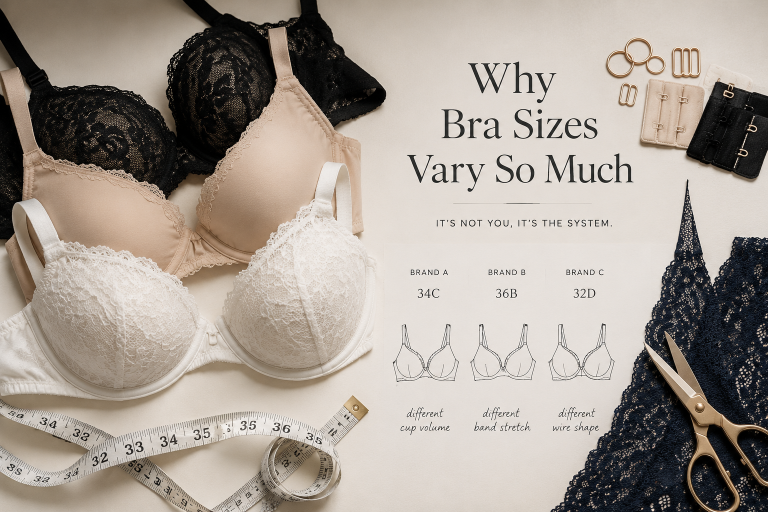
Why Bra Sizes Vary So Much
Ever wondered why you're a 36C in one brand and a 38B in another? Learn why bra sizes vary, how manufacturers design bras differently, and what really matters when finding your perfect fit.
Have you ever wondered why you're a 36D in one brand but a 38C in another?
You're not imagining it.
Manufacturers use different:
Cup patterns
Wire shapes
Stretch fabrics
Band elasticity
Design goals
Some brands are designed for fuller busts.
Others are designed for shallower breast shapes.
Some prioritize comfort.
Others prioritize appearance.
That's why one of the most frustrating experiences when shopping for bras is discovering that your "usual size" doesn't fit.
You finally find a bra labeled 36D that fits beautifully. Then you try another 36D from a different brand—and suddenly it's too tight, too loose, too shallow, or too deep.
It's enough to make anyone question their size.
The truth is, you're probably not the problem.
Bra sizing isn't standardized, and understanding why can make shopping much less frustrating.
There Is No Universal Bra Size Standard
(Hero image: Your "Why Bra Sizes Vary So Much" image.)
Unlike many products, there isn't one worldwide standard that every bra manufacturer follows.
Each company develops its own:
Patterns
Cup shapes
Underwires
Band elasticity
Sizing methods
Fit models
That means a 34DD from one brand may fit very differently from a 34DD made by another company.
The label may be the same—but the bra is not.
Every Brand Designs for a Different Customer
Not every lingerie company designs for the same body type.
Some brands specialize in:
Fuller busts
Petite frames
Fashion-forward styles
Everyday comfort
Sports bras
Luxury lingerie
As a result, their bras are built with different proportions, different support levels, and different expectations about the person wearing them.
Cup Shape Matters Just as Much as Cup Size
(Image showing two different cup shapes.)
Many women assume that cup letters tell the whole story.
They don't.
Two bras labeled the same size may have completely different cup shapes.
One may be:
Deeper
Shallower
Wider
Narrower
More open across the neckline
More closed at the top
That's why one bra may fit beautifully while another gaps or feels too tight—even though both have the same size on the tag.
The Band Makes a Difference
Band elasticity varies between manufacturers.
Some brands use firmer elastics.
Others use softer materials that stretch more easily.
This means:
One 36 band may feel like another brand's 34.
Another may feel closer to a 38.
It's perfectly normal to wear different band sizes in different brands.
Sister Sizes Can Help
(Image illustrating sister sizing.)
Sometimes adjusting both the band and cup provides a better fit.
For example:
34D
36C
38B
These are called sister sizes.
They have similar cup volume while changing the band size.
Understanding sister sizing can make it easier to find a comfortable fit when your preferred size isn't available.
Your Body Changes Over Time
Your bra size today may not be your bra size next year.
Many things affect fit, including:
Weight changes
Pregnancy
Breastfeeding
Hormonal changes
Menopause
Exercise
Surgery
Aging
It's completely normal for your bra size to change over time.
The Number on the Tag Isn't the Goal
One of the biggest mistakes women make is becoming attached to a particular size.
The goal isn't wearing a certain number or letter.
The goal is wearing a bra that:
Feels comfortable
Provides support
Fits your breast shape
Stays in place
Makes you feel confident
If that happens to be a different size than you expected, that's perfectly okay.
Why Professional Fittings Help
A professional fitter looks beyond the label.
Instead of focusing only on measurements, they evaluate:
Breast shape
Breast spacing
Projection
Root width
Support needs
Lifestyle
Comfort preferences
That's why professional fittings often produce better results than relying solely on a size calculator.
When a Custom Bra Is the Best Solution
Sometimes no amount of trying different brands solves the problem.
This is especially true for women with:
Significant asymmetry
Hard-to-find sizes
Post-surgical changes
Unique body proportions
Specialty wardrobe needs
A custom bra eliminates the guesswork by being designed specifically for your body rather than around standardized sizing.
The Bottom Line
Bra sizing is a helpful guide—but it's not an exact science.
Different brands, different patterns, different materials, and different breast shapes all influence how a bra fits.
Instead of chasing the "right" size, focus on finding the bra that feels right for your body.
That's the size that truly matters.
Ready to Stop Guessing?
At Lynnette January Design Studio, we believe the best-fitting bra begins with understanding your unique body—not simply reading the size on a label.
Whether you're searching for a better-fitting ready-to-wear bra, need alterations, or want a completely custom design, we're here to help.
If changing brands and sizes still hasn’t solved your fit problems, visit Lynnette January Design Studio during walk-in hours for a professional Bra Assessment & Fit Consultation. No appointment is necessary.