
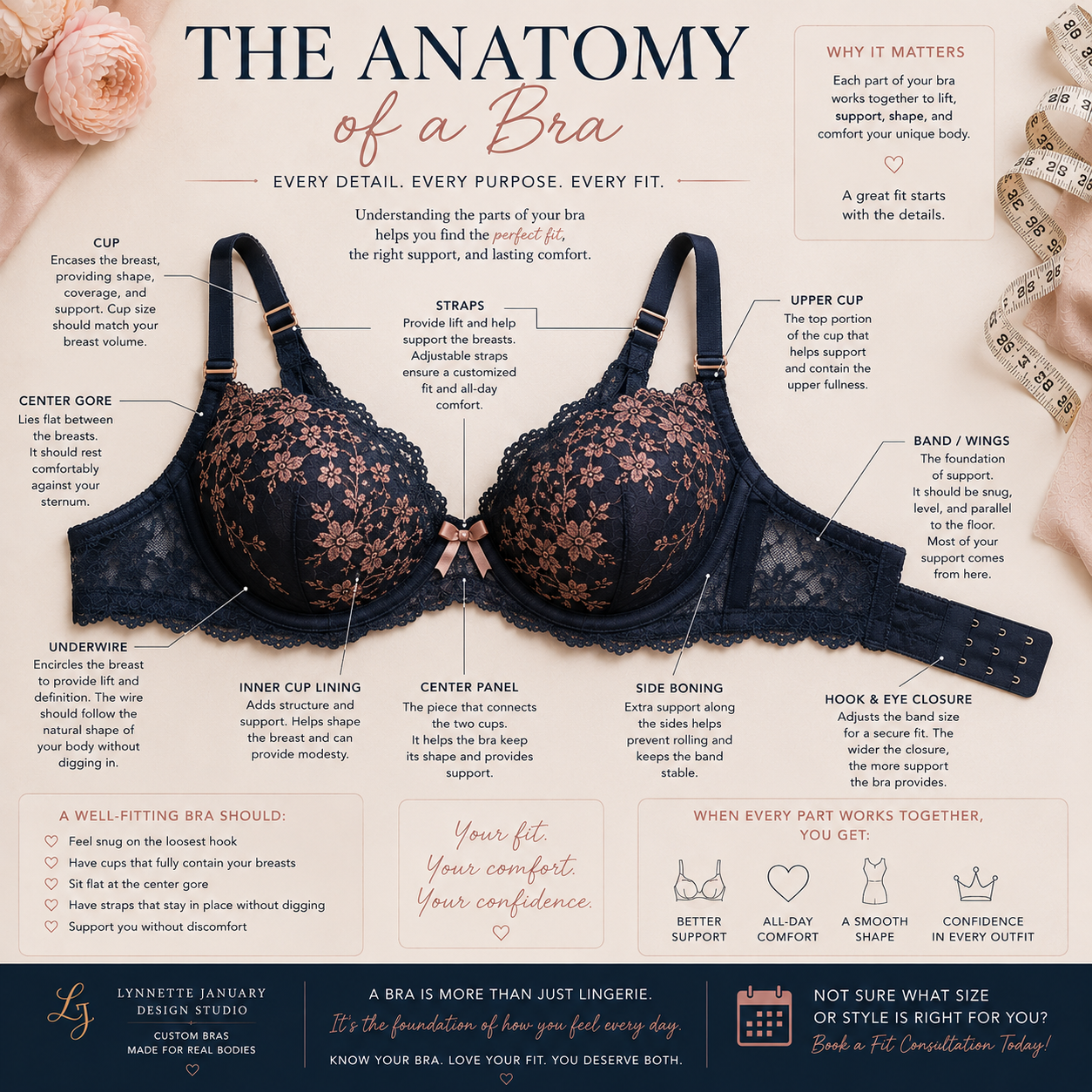
The Anatomy of a Bra: Understanding Every Part and Why It Matters
Ever wondered what every part of your bra actually does? From the cups and underwires to the band, gore, and straps, understanding bra anatomy can help you find a better fit and appreciate the craftsmanship behind every custom bra.
The Anatomy of a Bra
At first glance, a bra may seem like a simple garment.
In reality, it's one of the most engineered pieces of clothing you'll wear.
Every strap, seam, elastic, and panel serves a specific purpose. When all of these parts work together correctly, your bra provides comfort, support, shape, and confidence throughout the day.
Let's explore each component.
1. The Cups
(Close-up image of the cups.)
The cups surround and support your breast tissue.
Cup size is only part of the equation—cup shape is equally important. Different cup constructions are designed for different breast shapes, fullness, and support needs.
2. The Upper Cup
(Close-up image.)
The upper cup helps determine how the bra fits across the top of the breast.
Depending on the design, it may be made from lace, mesh, stretch fabric, or non-stretch materials to provide shaping, lift, or flexibility.
3. The Lower Cup
(Image.)
The lower cup provides most of the lift and support.
In many bras, it's made from stronger fabrics because it carries much of the breast's weight.
4. The Underwire
(Image.)
The underwire surrounds—not sits on—your breast tissue.
A properly fitted underwire distributes weight, provides support, and helps maintain cup shape.
Contrary to popular belief, underwires themselves aren't uncomfortable—poor fit usually is.
5. The Center Gore
(Image.)
The gore is the center panel between the cups.
In most underwire bras, it should rest comfortably against your breastbone.
If it doesn't, the bra may be the wrong size or shape.
6. The Band (Wings)
(Image.)
The band provides approximately 80% of a bra's support.
It should fit snugly and remain level all the way around your body.
Many people mistakenly believe the straps provide most of the support—but the band does the heavy lifting.
7. The Straps
(Image.)
Straps stabilize the cups and help position the bra correctly.
They should never be responsible for supporting the full weight of your breasts.
If your straps constantly dig into your shoulders, your band likely needs attention.
8. The Hook & Eye Closure
(Image.)
The hook-and-eye closure allows the band to be adjusted as the elastic naturally stretches over time.
A new bra should generally fit comfortably on the loosest hooks.
9. The Channeling
(Image.)
Channeling is the fabric casing that holds the underwire securely in place.
It protects both the wire and the wearer while allowing the bra to maintain its structure.
10. The Power Bar (When Present)
(Image.)
Many supportive bras include an internal side support panel, often called a power bar.
This panel gently directs breast tissue forward and provides additional lift and shaping.
It's especially useful for fuller busts.
11. Elastics
(Image.)
Different elastics perform different jobs.
Some provide gentle flexibility.
Others stabilize the neckline, underarm, or band.
Choosing the correct elastic is one of the details that separates a high-quality bra from an average one.
12. Fabrics
(Image.)
Every fabric has a purpose.
A custom bra may combine:
Lace
Powernet
Duoplex
Stretch satin
Bra tulle
Mesh
Foam
Linings
Each contributes to comfort, durability, support, or appearance.
Why Bra Anatomy Matters
Once you understand how every component works together, shopping for—or designing—a bra becomes much easier.
You'll know why one bra feels amazing while another doesn't.
You'll understand why fit is about much more than the size on the label.
And you'll begin to appreciate the craftsmanship that goes into creating a bra that truly fits.
Looking Beyond the Label
The best bra isn't necessarily the most expensive one.
It's the one designed for your unique body.
Whether you're purchasing ready-to-wear or investing in a handcrafted custom bra, understanding bra anatomy helps you make informed decisions and enjoy greater comfort every day.
Ready to Experience Better Fit?
At Lynnette January Design Studio, we believe every detail matters.
From the smallest stitch to the final fitting, every part of your bra is thoughtfully chosen to provide exceptional comfort, support, and beauty.
Book a consultation today and discover the difference a well-designed bra can make.
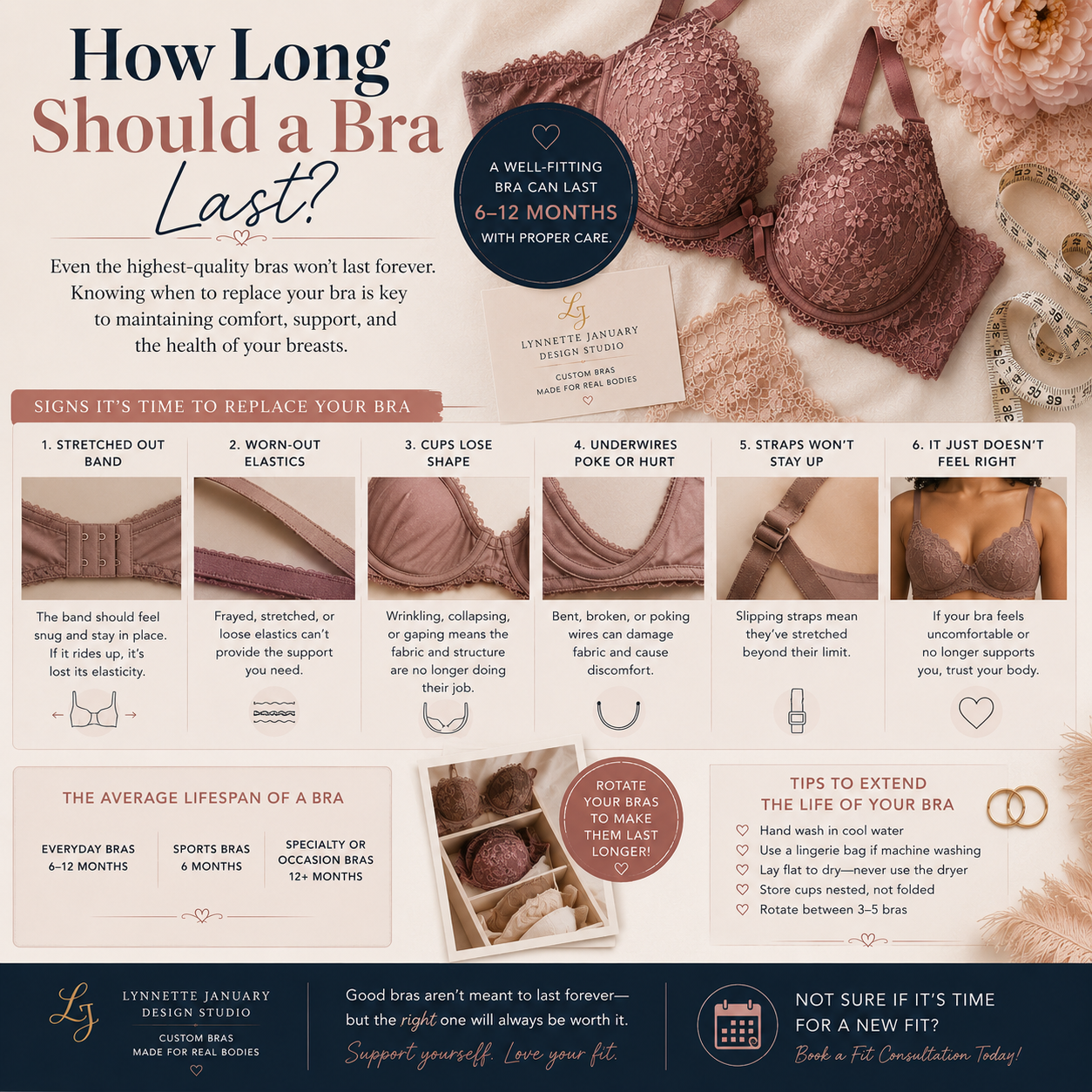
How Long Should A Bra Last?
Bras don't last forever—but with proper care, they can serve you well for years. Learn how long a quality bra should last, what causes it to wear out, and the signs it's time for a replacement.
A well-made bra is an investment in your comfort and confidence, but even the highest-quality bra won't last forever.
How long your bra lasts depends on several factors, including how often you wear it, how you care for it, the quality of its materials, and how well it fits.
While there's no exact expiration date, understanding the signs of wear can help you know when it's time to replace—or repair—your favorite bra.
The Average Lifespan of a Bra
(Image of several beautiful bras arranged neatly.)
Most quality bras last 6 to 18 months with regular wear.
However, if you rotate several bras instead of wearing the same one every day, each bra may last much longer.
The more often you wear and wash a single bra, the faster its elastic and support materials will wear out.
Five Signs It's Time for a New Bra
1. The Band Has Lost Its Stretch
(Close-up of stretched elastic.)
The band provides most of your bra's support.
If it feels loose even on the tightest hooks, the elastic has likely reached the end of its life.
2. The Cups No Longer Fit Properly
(Image showing wrinkled or distorted cups.)
Over time, cups can lose their shape.
If you're experiencing wrinkles, collapsing foam, or reduced support, it may be time for a replacement.
3. The Underwire Is Poking Through
(Close-up of damaged channeling.)
A protruding underwire usually means the channeling has worn through.
Sometimes this can be repaired, but severe damage may require replacing the bra.
4. The Straps Won't Stay Adjusted
(Image of adjustable straps.)
If your straps constantly loosen or the elastic has become stretched out, your bra may no longer provide the support it once did.
5. You're Constantly Adjusting It
(Lifestyle image.)
If you're pulling your bra down, lifting the cups, tightening straps, or repositioning throughout the day, your bra may have simply reached the end of its useful life.
Can Your Bra Be Repaired Instead?
One of the biggest misconceptions is that every worn bra needs to be replaced.
In many cases, a favorite bra can be given new life through professional alterations.
Depending on the condition, services may include:
Replacing hook-and-eye closures
Installing new elastic
Shortening or replacing straps
Replacing underwires
Repairing channeling
Minor structural repairs
If the cups and overall construction are still in good condition, repairing a bra can often be more economical—and more sustainable—than replacing it.
Tips to Make Your Bras Last Longer
A few simple habits can significantly extend the life of your bras.
✔ Rotate between several bras.
✔ Hand wash whenever possible.
✔ Use a lingerie bag if machine washing.
✔ Fasten hooks before washing.
✔ Lay bras flat to dry.
✔ Avoid high heat from dryers.
✔ Store molded cups carefully to prevent crushing.
These small steps help preserve the elastic, fabric, and overall structure.
Quality Matters
Not all bras are made the same.
Higher-quality materials, stronger elastics, and better construction techniques generally result in bras that maintain their support and shape longer than lower-quality alternatives.
When cared for properly, a well-crafted bra often provides better value over time.
The Bottom Line
A bra should support you—not frustrate you.
If your bra no longer fits comfortably, has lost its elasticity, or requires constant adjustment, it may be time for a replacement or a professional alteration.
Taking care of your bras and knowing when to repair or replace them helps ensure you continue to enjoy the comfort and support you deserve.
Need Help Deciding?
Not sure whether your favorite bra can be saved?
At Lynnette January Design Studio, we offer professional bra assessments to determine whether a bra can be altered, repaired, or whether it's time to explore a new custom design.
Schedule a consultation today and let us help you get the most from every bra in your wardrobe.
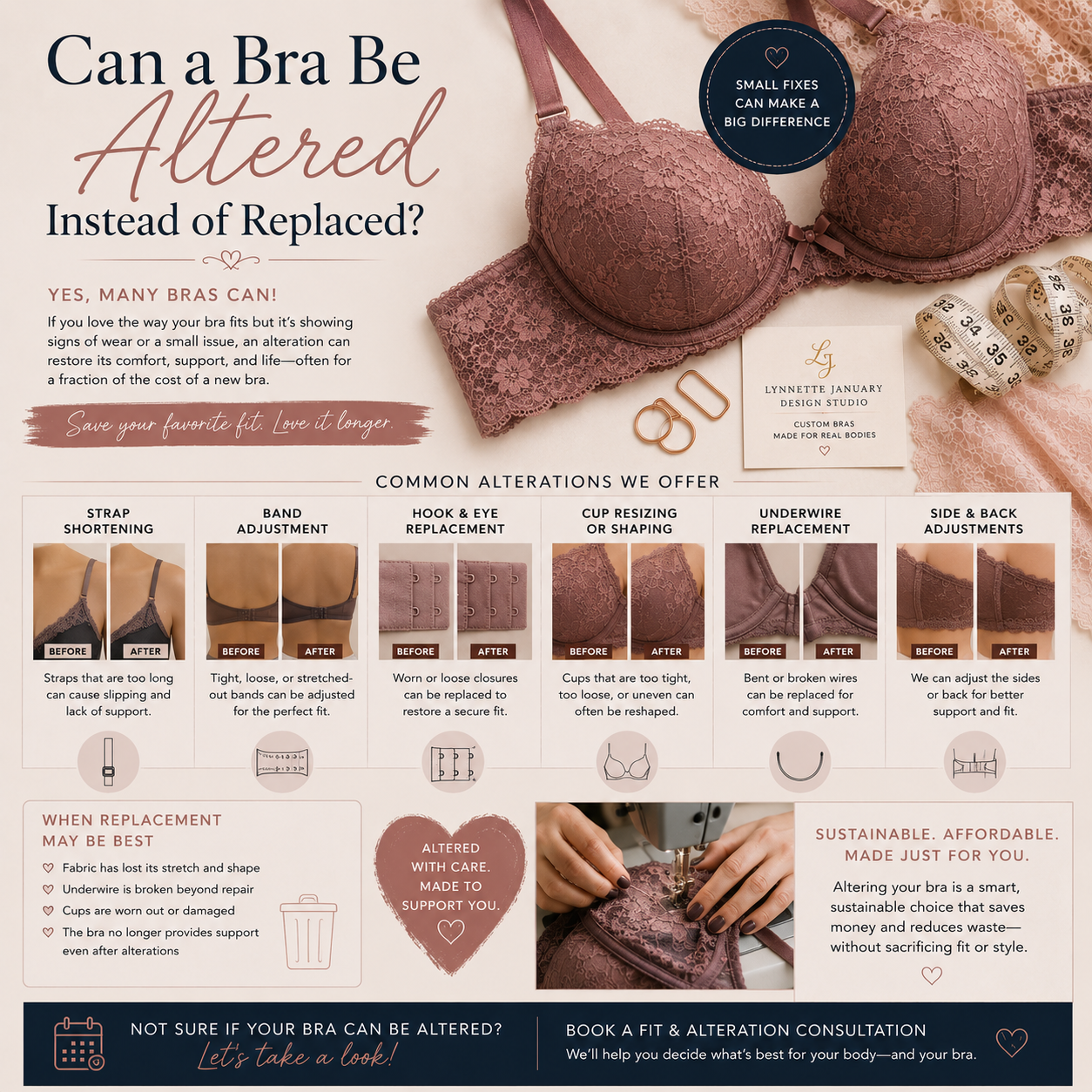
Can A Bra Be Altered Instead Of Replaced?
You don't always need a new bra. Many common fit problems can be corrected with professional alterations. Learn what can—and can't—be altered before replacing your favorite bra.
Finding a bra you truly love isn't always easy.
Maybe it's the perfect color. Maybe it's the most comfortable bra you've ever owned. Or maybe it's the only one that fits just right.
When that bra starts showing signs of wear—or your body changes—you may assume it's time to replace it.
Fortunately, that's not always the case.
Many bras can be professionally altered or repaired, extending their life while improving comfort and fit.
Let's look at what's possible.
Why Alter a Bra?
(Hero image: Before-and-after bra alteration.)
Bodies change.
Weight fluctuates.
Elastic stretches.
Breasts change after pregnancy, surgery, or aging.
Instead of replacing a favorite bra, an alteration can often restore its support and make it comfortable again.
Common Bra Alterations
Band Adjustments
(Photo of a shortened bra band.)
If your band has become too loose, it can often be shortened to restore proper support.
A supportive band is the foundation of a well-fitting bra.
Strap Shortening or Replacement
(Photo of new straps.)
Loose or stretched straps are one of the most common complaints.
Replacing or shortening straps can dramatically improve comfort and lift.
Hook & Eye Replacement
(Close-up of a new closure.)
Over time, closures wear out.
Replacing the hook-and-eye tape is a relatively simple repair that can extend the life of your bra.
Underwire Replacement
(Photo of channeling and wire.)
If an underwire has bent, broken, or poked through the fabric, it may be possible to replace the wire and repair the channeling.
Cup Modifications
(Photo of cup alteration.)
Depending on the design, cups may be adjusted to improve fit.
Small modifications can reduce gaping, improve support, or accommodate mild breast asymmetry.
Adding Special Features
A bra can often be customized with features such as:
Prosthesis pockets
Additional padding
Foam inserts
Gel inserts
Strap conversions
Decorative lace
Improved closures
These changes can improve both function and appearance.
When Alterations May Not Be Worth It
Not every bra can be saved.
Replacement may be the better option if:
The fabric is severely worn.
The elastic has completely failed throughout the bra.
The cups have lost their structure.
Multiple major repairs are needed.
The bra never fit correctly to begin with.
Sometimes starting fresh is the better investment.
Repair or Replace?
Ask yourself:
✔ Do you love the bra?
✔ Does it fit well except for one or two issues?
✔ Is the fabric still in good condition?
✔ Would a small alteration solve the problem?
If the answer is yes, an alteration may be the perfect solution.
When a Custom Bra Is the Better Choice
Sometimes alterations simply can't solve the underlying problem.
If you've struggled for years to find a comfortable bra, have significant asymmetry, need post-surgical support, or require a hard-to-find size, a custom bra may provide a better long-term solution.
Custom bras are designed around your body rather than asking your body to adapt to a standard size.
The Bottom Line
A worn bra doesn't automatically belong in the trash.
Many common issues can be repaired, resized, or customized, allowing you to continue enjoying a bra you already love.
Knowing when to alter and when to replace can save money, reduce waste, and improve your everyday comfort.
Not Sure Which Option Is Best?
At Lynnette January Design Studio, we evaluate each bra individually.
If an alteration will restore its fit and function, we'll recommend it.
If a replacement—or a completely custom bra—is the better solution, we'll explain why and help you choose the option that best meets your needs.
Schedule a Bra Assessment & Fit Consultation to find out whether your favorite bra can be given a second life.